Posts

Escapee

Image
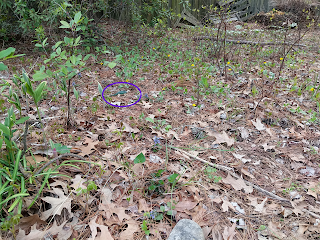
B aja Fibiger is home to many species of dinosaurs that have managed to survive in this hidden part of the Americas for millions of years. I'm sure you have seen some of them during rides around Fibiger Park, the area that we allow tourists to visit. While the dinosaurs are free to roam, we do monitor their health and try keep them from wandering too far from the park.  Today while doing my rounds I wasn't able to find one of the Euoplocephaluses that has been spending time around the park and was due for some blood work. Nothing serious, just a check to make sure she was doing well coming out of the cool winter months. Euoplocephalus (pronounced you-OH-plo-kef-ah-luss) are one of my favorite herbivores with their rows of spikes on the back for protection. We have yet to see one attacked even though they do draw the attention of the carnivorous creatures when they pass. Also, the spikes, being about six and a half meters long offer a good deterrent. Despite their look, they are...
Learning to take a dump

Image
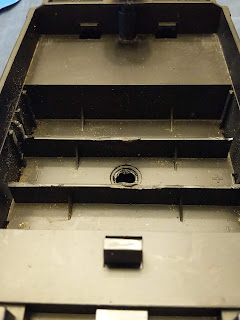
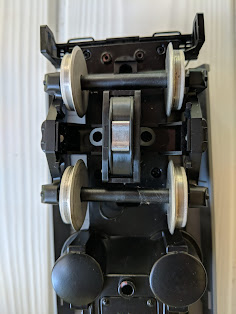
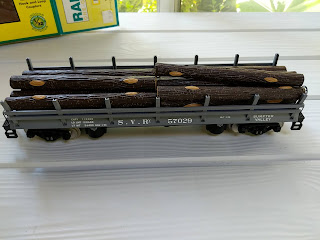
I bet that caught your attention. Back in the fall, someone in my local train club sold off a bunch of equipment from a guy who was closing down his railroad. Among the items available were a couple of log cars, something I had been thinking about adding to my collection. I usually wait-and-think with the result that everything good is gone before I'm ready.  Not this time! I made a quick offer for one of the log cars. The price was good so when I was offered both for about 50% more, I went for it. When I picked them up, I found out they came with a piece of track with a middle rail to trigger the car to dump to the side. The cars are in fabulous shape and in their original boxes. They are MTH Operating Log Cars . The instructions talk about hooking up the middle rail to a separately-purchased switch box to activate the dumping. That system was more than the cost of the cars and I figured I should be able to figure it out without much trouble. To start working it out, I thought I...
Image
 Greetings friends of Coastal Titans Railroad. I am Bartolome Thorvaldsen, Chief Engineer for the line and I wanted to share with you some of the grand happenings on the railroad this past year. The turning of year is a great time to see how far we have come and dream of where we want to go.   The best part of my year was adding four new cars to our stock. We were able to acquire a pair of log transport cars from a railroad in the States that was closing down and they were received in the fall. They are nice looking and run smoothly. They will be a good addition as we move forward. We also had a second passenger car offered to the line. It just arrived in the shops and hasn't been out on the rails yet but looks good. Our visitors will enjoy the ride in comfort. And speaking of the shop, the team constructed a bulb dumping car for use when we move these ginormous plants for export .  One of the new log cars The Bulb Dumping car built in-house The shop was busy as earl...

Seeing the Light

Image
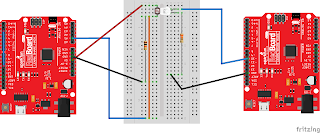
  One of my hopes for the garden railroad is to be able to build some of my own electronics for it. Whether some off-track movement or lights, or a piece of automation that helps manage the trains. It would be very useful to be able to control the automation from the DCC throttle. So there is my starting point: build an Arduino system that listens to DCC and does something with the signal.  After some searching on line I found several options and settled on the basic design from  Dave Bodnar at Train Electronics . One of the components needed is an optocoupler. I wasn't familiar with this so did some reading and turns out, this is a pretty ingenious little device. It provides a way to have signals pass from a high voltage part of a circuit (for me DCC running at about 15-18V) to a low voltage part (the Arduino at 3.3 or 5V) while having them electrically isolated. The incoming signal get converted to light (hence to opto-) which is picked up by a photodetector and sent ba...

How far have we come?

Image
 This is part 2 of  How Far Do We Go  from a few months ago. I left off there with a working prototype of an Arduino-based odometer installed in my refrigerator car. That car was part of a starter kit and doesn't fit well with my theme right now so it is doing duty as a utility and testing car. It was the first car where I replaced the default hook-and-loop coupler with a knuckler coupler. It now is the transition between the starter set and a few of cars I have acquired that came with knuckle couplers. However, as I ended the previous post, that car didn't lend itself very well to having a display or a battery pack with easy access.  So I've torn that all out and started with a fresh design. The new design would have a four-line LED display, instead of two-line, to show more data and I decided to have a dedicated Arduino board. After trying a few combinations, I realized that the coal tender would be a perfect place for the odometer. It has a removable coal load wit...

Early Spring 2021

Image
On Easter weekend old 814 went out for a run with the first tourists of the season. The plants were blooming and the dinos well behaved. 

Stop the Bouncing

Image
This is the first of what hopefully will be several posts that are focused on electronics projects. I have been developing an interest in electronics, and Arudino in particular, along side the model trains. As described in a recent post about building an odometer for the train , when including a switch care must be taken to avoid " switch bounce " or the mechanical rapid bouncing as the switch is triggered or released. If the program is fast enough, these bounces will be seen as separate events when you are expecting it to be a single event. This can be addressed either in the software or through circuit design. Since I wanted to use an interrupt for the trigger and am not sure of how fast the railcar might go, I decided to use the circuit approach.  I had three circuit design alternatives and wanted to test them out for their effectiveness.  Option #1 : Simplest (and winner) In the Garden Railroad story that inspired the odometer, he uses a 10 nF capacitor in parallel with t...